

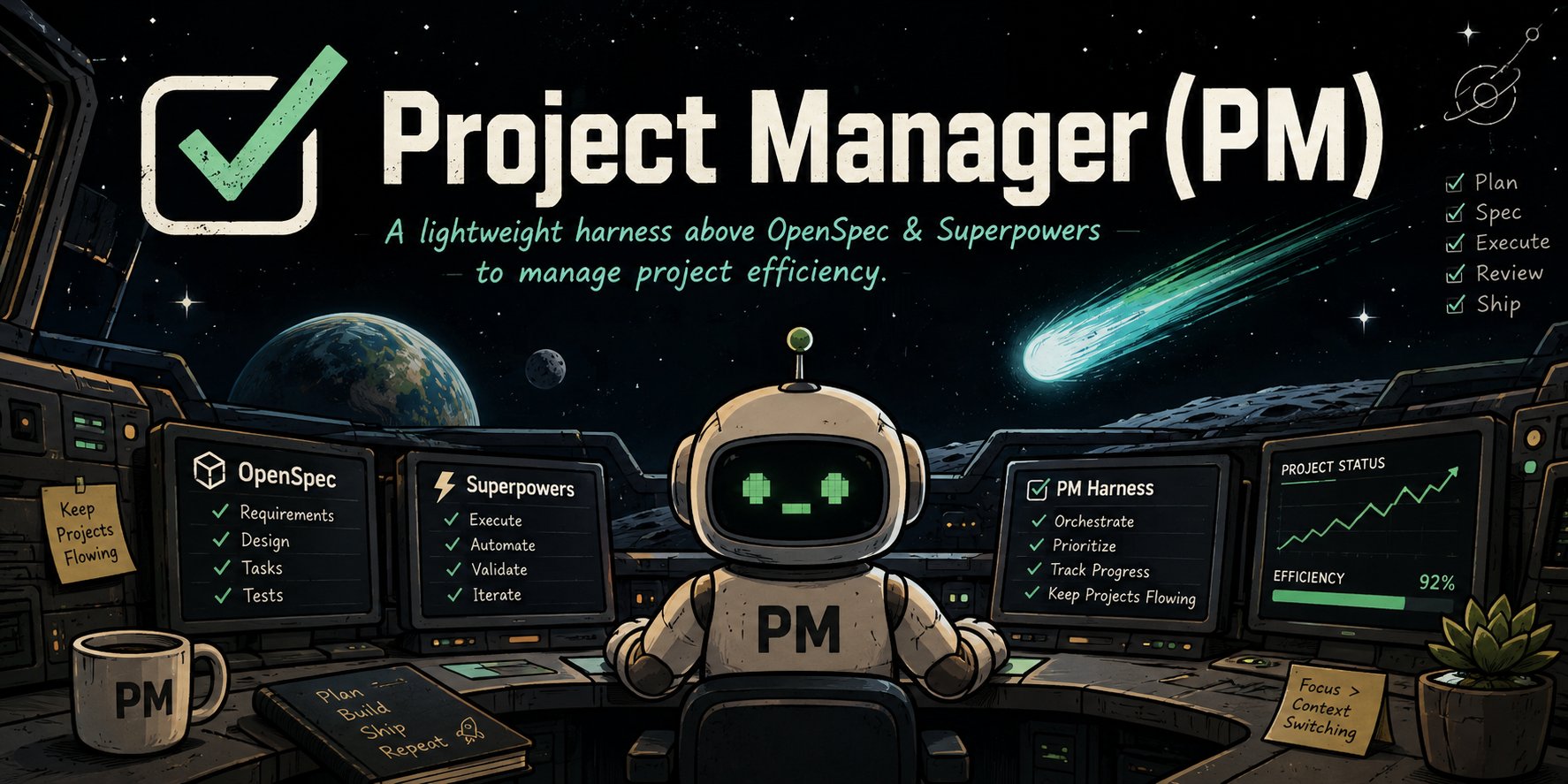
/pm:init, and it stays oriented across every context compaction. Zero npm dependencies. Pure Node 22+ built-ins.
Introduction
Why PM exists, the problem it solves, and real numbers pulled from its own history.
Installation
Install PM from the cfdude-plugins marketplace in under a minute.
Quick Start
Initialize PM in your project and run your first briefing in five steps.
Core Concepts
Understand epics, lanes, the detour stack, and the reconcile gate.
How It Works
1
Initialize
Run
/pm:init in your project. PM scaffolds .conductor/state.json, writes a managed rules block into CLAUDE.md, and registers any existing OpenSpec proposals or Superpowers plans as epics. A SessionStart hook is installed that re-injects the full project briefing after every context compaction — automatically.2
Work epics in lanes
Every unit of work is an epic routed through a lane —
openspec (spec-driven proposal workflow), superpowers (execution-focused TDD), claude-code (direct implementation), decision (lightweight ADR), or external (tracker-mirrored). /pm:status shows the current briefing; /pm:next picks the highest-priority item, respecting depends-on links and the detour stack.3
Handle interrupts without losing context
When something comes up mid-build,
/pm:detour classifies it as minimal (fix-in-place, log it, resume) or substantial (PUSH the current epic, spin up a new one, build the interrupt). When the detour is done, /pm:resume POPs the stack and fires the reconcile gate — a fresh-context agent re-validates the paused epic against what the detour actually shipped before a single line of code is written.The Detour Stack in Action
Here is what a substantial interruption looks like before and after PM: Without PM: You’re mid-build onauth-refactor when a prod bug comes in. You either abandon auth-refactor context or ignore the bug. After fixing the bug, you resume from memory — which may be wrong after a compaction.
With PM:
PreToolUse block on Edit/Write/NotebookEdit until the gate clears. The agent cannot accidentally skip it.
What PM Tracks
Handling Detours
Park current work, build the interrupt, and resume with confidence.
Multi-Agent Hierarchy
Dispatch child epics as worktree-isolated agents that merge back cleanly.
External Trackers
Mirror epics to Jira, Linear, or GitHub Issues without leaving Claude Code.
Daily Workflow
How a full session looks from
/pm:init to closing the last epic.Key Features
Detour Stack
PUSH/POP your working context around any interruption. The stack survives compaction and is re-injected by the SessionStart hook on every resume.
Reconcile Gate
A mandatory fresh-context review fires on every resume — a
PreToolUse hard block, not a suggestion. No code is written until the gate clears.Zero Dependencies
The engine is pure Node 22+ built-ins. Nothing to
npm install, ever. See the Introduction for current test/line counts.Session Briefing
A
SessionStart hook re-injects the full project briefing after every context compaction — automatically, without any manual step.Multi-Agent Dispatch
Run parent epics as batched, worktree-isolated child agents that converge via sequential merge. The orchestrator is the sole writer of shared state.
Tracker Mirroring
Instruction-layer sync to Jira, Linear, or GitHub Issues. The engine never calls external APIs — it shapes the instructions that tell the agent to.
Concepts
Epics and Lanes
How work units are defined, routed through lanes, and prioritized.
Detour Stack
The PUSH/POP mechanism that makes any interruption safely resumable.
Reconcile Gate
The fresh-context re-validation gate that fires on every resume.
State and Project
How
.conductor/state.json and PROJECT.md are structured and maintained.Command Reference
/pm:init
Scaffold the conductor, register epics, write the CLAUDE.md rules block.
/pm:status
Show the current briefing: active epic, detour stack, priority queue, lane counts.
/pm:next
Pick the next highest-priority item, respecting the detour stack and dependency links.
/pm:detour
Classify and handle a mid-build interruption — minimal or substantial.
/pm:resume
Pop the detour stack and run the reconcile gate before resuming.
/pm:epic
Register, update, or remove epics directly.
/pm:hierarchy
Plan and dispatch a parent epic’s children as a multi-agent batch.
/pm:sync
Pick up new proposals, plans, and inbound tracker issues as epics.
/pm:tracker
Configure mirroring to Jira, Linear, or GitHub Issues.
/pm:upgrade
Refresh the CLAUDE.md rules block and run any pending migrations.
/pm:feedback
File a bug or feature request as a GitHub issue directly from a session.
All Commands
View the full command reference including gate-guard, lane-routing, and review-mode.
PM is Claude Code only today. Support for Codex, Gemini CLI, Grok Build, and generic
AGENTS.md-based platforms is tracked under multi-platform-agent-support in PM’s own backlog.